Real timber faces
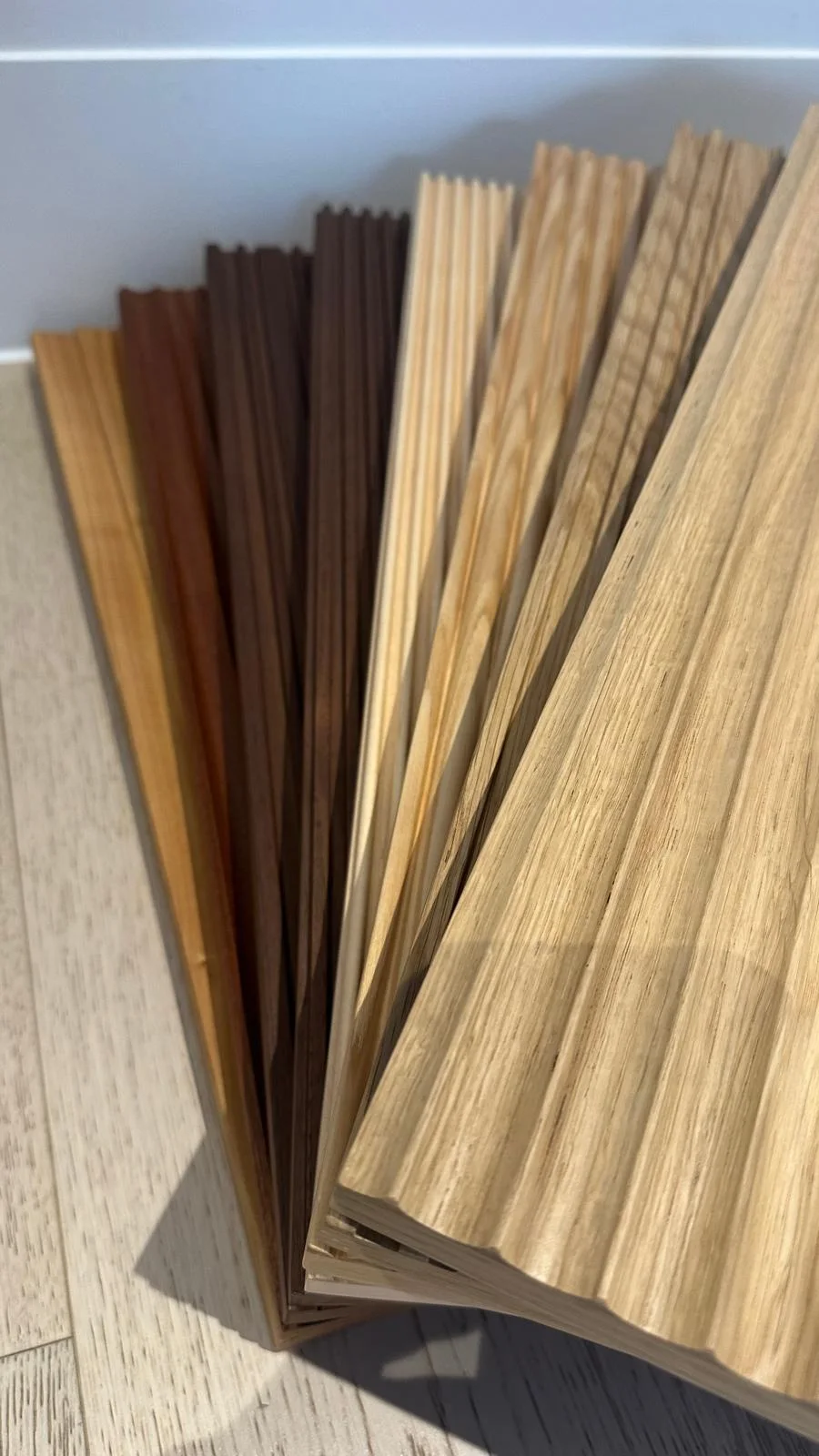
European oak offers a warm neutral grain and broad staining range. American walnut offers deeper brown tones and expressive variation. Both should be approved on the intended profile and finish.

Specification matrix / Materials
A fluted surface is a construction, not only a colour. Timber, core, reverse balance, thickness, edge and finish must work together for the intended component.
Direct answer / Specification summary
Current online choices include European oak or American walnut over MDF or plywood, with total thickness, raw or finished surface, and matching veneer or solid timber edges selected per project. Final compatibility is confirmed during quotation.
Material + specification
European oak offers a warm neutral grain and broad staining range. American walnut offers deeper brown tones and expressive variation. Both should be approved on the intended profile and finish.
MDF provides a consistent machining and lamination base; plywood can be selected where its construction characteristics or exposed edge strategy are relevant. The correct grade and build-up depend on the component. In technical specifications, this core layer may also be called the substrate.
Total thickness combines the profiled face, core and balancing construction. A reverse balance helps manage panel behaviour, but overall size, environment, storage and fixing remain important.
Raw supply suits workshops applying their own system. Clear matt lacquer, natural oil and tinted finishes each change colour, sheen, maintenance and repair characteristics. Approve a labelled physical sample.
Edges may remain for workshop treatment or be completed with matching veneer or solid timber lipping. The choice depends on impact risk, visible thickness, profile termination and desired joinery detail.
Project support / UK
Share the application, dimensions, quantities and programme. We can guide profile, timber, construction, finish and supply format before quotation.
Start a project conversationSpecification FAQ
Concise guidance for professional design and joinery teams. Project-specific requirements are confirmed on the approved specification.
Typically the visible surface is real timber over a stable core. Solid timber may be used for appropriate lippings and details.
A selected core provides a consistent panel construction, supports machining and can be more suitable for large joinery components than solid timber alone.
Colour matching can be assessed from a physical reference, but approval must be based on a project sample because timber varies.
Maintenance depends on finish chemistry and use. We provide the selected finish information so the project team can follow the correct care method.